
What is an AI Virtual Assistant? AI-Trained Human VAs vs AI Bots
An AI virtual assistant is a tool or service that uses artificial intelligence to handle day-to-day business tasks like scheduling, drafting, research, and customer replies. The term now covers two quite different things: automated AI bots and human VAs who are trained to work with AI.
People overlook how much that difference matters. One is software that runs on prompts. The other is a person who uses AI to work faster and still takes ownership of the result.
This guide covers how each one works, where each one falls short, and how to pick the right AI virtual assistant for your business.
What Is an AI-Trained Virtual Assistant?
An AI-trained virtual assistant is a human VA who uses AI tools as part of their daily workflow. They use AI for first drafts, research, and admin, then apply their own judgment before anything goes out. You get AI’s speed, with a person accountable for the result.
In practice, it goes like this:
- The VA uses AI to draft a client reply in seconds.
- They check the facts, fix the tone, and add context only a person would know.
- They send it and answer for it.
That review step is what makes it work. It’s the same logic behind a human-in-the-loop workflow for AI content fact-checking, where a person verifies every claim before anything is published.
What Does an AI Virtual Assistant Actually Do?
An AI virtual assistant uses language models and automation to complete set tasks with little or no human input. It can draft emails, summarise documents, book meetings, answer common questions, and tidy up data. It works best on repeatable, rule-based work.
Most business owners come across an AI-powered virtual assistant in one of two forms:
- AI bots and chat tools: software that responds to prompts or runs automated workflows.
- AI-trained human VAs: real people who use AI tools every day and check every output before it reaches you.
Both get called an AI virtual assistant, but they aren’t the same product, and they don’t carry the same risk.
For many small teams, an AI assistant for business is the first step into automation. What matters is how much of the work should stay with a person.
Human vs AI Assistant: A Side-by-Side Look
A human vs AI assistant comparison works best task by task, not by headline. Here’s how the two stack up on the points that matter most:
- Speed: bots win on raw speed. An AI-trained VA is slightly slower, but the work arrives already checked.
- Judgment: humans clearly win. A VA weighs context, priorities, and tone, while a bot follows patterns.
- Cost: bots cost less per task. A human VA costs more per hour, but the cheaper option on paper isn’t always cheaper once you count the time you spend fixing errors.
- Accountability: a person answers for mistakes. A bot can’t.
- Context: a VA remembers your clients, your brand voice, and your habits over months. Most bots need you to supply that context again every time.
- Scope: bots handle narrow tasks. A VA handles a mixed workload, from inbox to client calls.
Neither one wins everywhere. It comes down to which tasks you’re handing over.
When a Bot-Only Setup Makes Sense
AI bots deserve a fair hearing. A bot-only setup is the better fit when:
- The tasks are repetitive, rule-based, and low risk.
- A wrong output costs you little, such as an internal summary or a meeting poll.
- You have time to review the results yourself.
- Your budget is tight, and the volume is high.
Examples include sorting incoming leads into categories, drafting first-pass meeting notes, or answering the same five shipping questions. A well-configured AI virtual assistant can handle those with light supervision.
When an AI-Trained Human VA Makes Sense
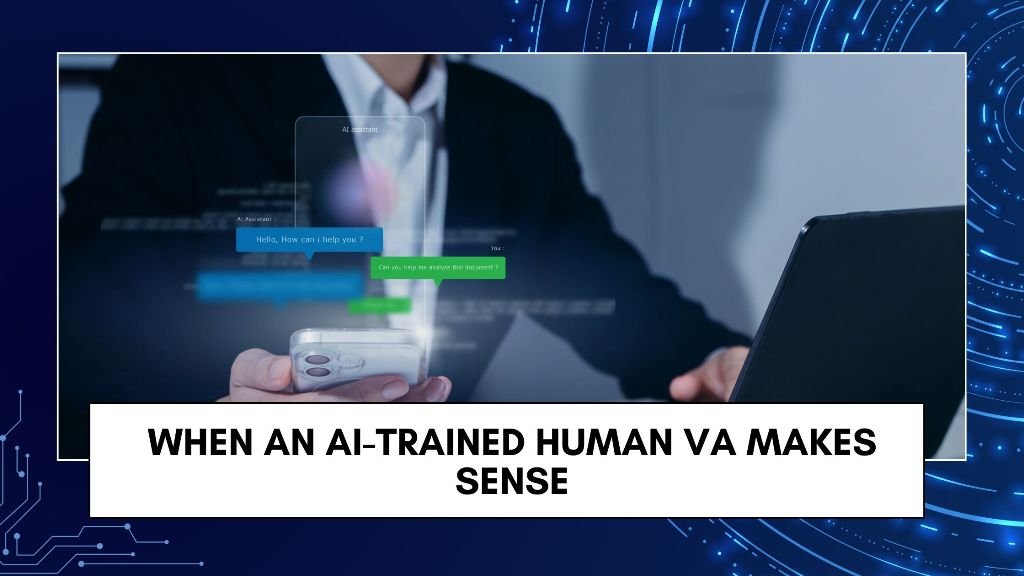
An AI-trained VA is the right fit when:
- The work involves clients, money, or your brand’s reputation.
- Tasks change week to week and need judgment.
- You want one accountable person instead of five disconnected tools.
- You don’t have time to check every output yourself.
Customer-facing work is the clearest example. Replies need both accuracy and warmth, and a human VA who uses AI for drafting can deliver both. Our guide to what a customer service virtual assistant does shows how that role works day to day.
Common Mistakes When Using an AI Virtual Assistant
Most problems come from how people use the tool, not from the tool itself. Four mistakes come up again and again:
- Treating the first draft as final: AI output needs a read-through, especially before it reaches a client.
- Skipping the brief: vague instructions produce vague work. Give examples of what good looks like.
- Automating a broken process: a messy workflow just fails faster with AI on top of it.
- Having no owner: if nobody is responsible for checking results, errors stay in the system.
A VA who is trained on AI tools tends to avoid all four, since reviewing and refining are already part of the job.
The Hybrid Model: Why Most Businesses Land Here

Most businesses don’t have to pick one. The strongest setup pairs AI tools with a human who directs them, which gives you an AI virtual assistant with a person accountable for the outcome.
The AI handles volume and speed. The VA handles judgment, quality control, and any work that doesn’t fit a template. That’s the basic idea behind AI-powered virtual assistant support that holds up over time.
A simple split to start with:
- Give to AI: summaries, first drafts, data sorting, and routine scheduling.
- Give to a human VA: client communication, final edits, and anything with your name on it.
- Review together: a weekly check of what the AI got wrong, so the process improves.
Unsure which tasks to hand off first? Our list of the top five tasks to outsource to remote staff is a practical starting point.
How to Choose the Right AI Virtual Assistant Setup
Before you decide, ask yourself three things.
- What does a mistake cost? If an error is cheap, lean towards automation. If it can lose a client, lean towards a human.
- How much time can you spend reviewing? Bots shift the work onto you as checking. A VA takes that off your plate.
- How much does context matter? The more your tasks depend on brand voice, history, or relationships, the more a human adds.
Then start small. Treat your first AI virtual assistant setup as a test, not a commitment. Pick one process, run it for 30 days, and measure what you actually saved in hours, errors, and rework. The results will show whether you need more AI, more human support, or both.
The Right Call for Your Business
The short version:
- An AI virtual assistant can be a bot or a trained human, and the two aren’t interchangeable. Know which one you’re buying.
- Bots are fast and cheap, but they need oversight.
- An AI trained virtual assistant pairs AI speed with human judgment and accountability.
- For most businesses, a hybrid model is the safest and most productive route.
Competitors who delegated this months ago are already ahead. If you want to see what an AI-powered virtual assistant plus a human VA could take off your plate, book a discovery call with our team, and we’ll help you work out the right mix.