
Virtual Assistant vs Social Media Agency: What’s the Right Choice for You?
Choosing between a virtual assistant vs social media agency is harder than it sounds. One day, you’re convinced you need a full social media agency. The next day, after seeing the invoice, you wonder if a single skilled virtual assistant could pull it off. If that cycle sounds familiar, you’re probably at the stage where this decision actually matters.
Most growing brands hit the same fork in the road: a virtual assistant vs social media agency. Both can post content, build communities, and drive sales. But how they work, what they cost, and how much of your time they eat are very different. What follows breaks down those differences so you can match the option to where your business actually is, not where you’d like it to be.
What a Social Media Virtual Assistant Does
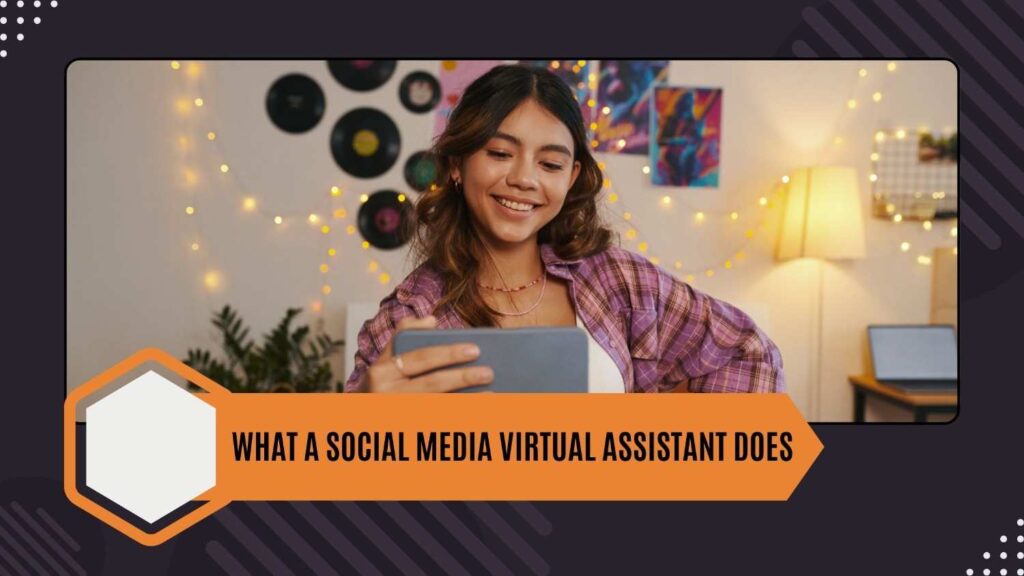
A virtual assistant focused on social media is a dedicated remote professional embedded in your brand. Think of them as an in-house social manager who doesn’t sit in your office. They write captions, schedule posts, design simple graphics in Canva, repurpose long-form content into short videos, respond to comments, and track basic performance metrics.
A good social media virtual assistant works with a small number of clients, which means they get genuinely deep into your brand voice, your audience, and your offers. You talk to them directly, often daily. They’re not a faceless team behind a project manager.
Whereas a social media agency is built to deliver at scale. You get a pod of specialists: a strategist, a copywriter, a designer, a video editor, a paid ads expert, and an account manager to coordinate them. The model is designed for breadth, influencer campaigns, paid funnels, high-end video, and coordinated launches across multiple platforms at once.
The trade-off: you communicate through an account manager, not the person making your content. Decisions move through approvals. That team is splitting its attention across many accounts.
The Core Differences: Virtual Assistant vs Social Media Agency
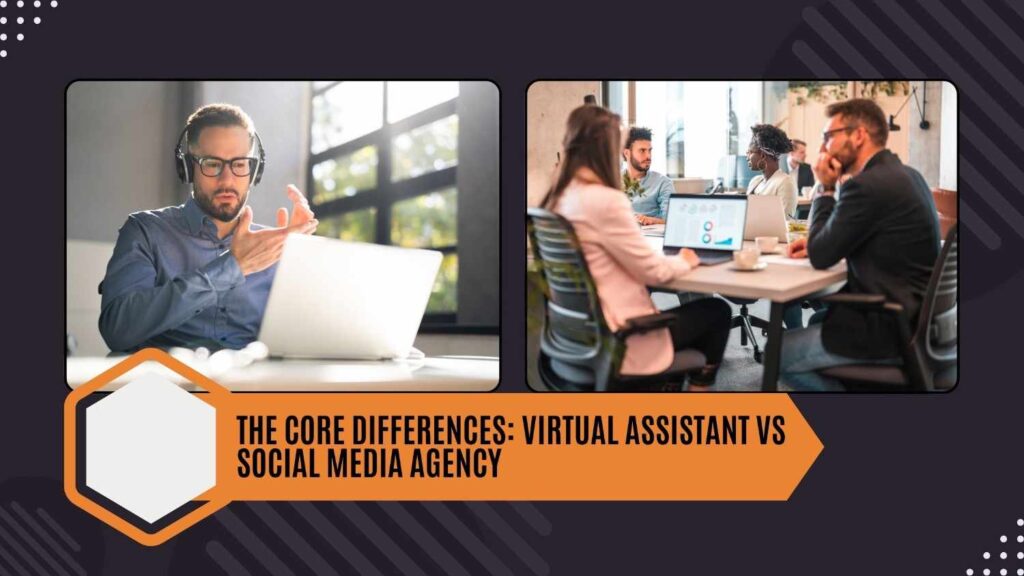
Both options can produce a content calendar and post to Instagram. The real differences between a virtual assistant and a social media agency show up in five areas.
Cost
A skilled virtual assistant typically runs $8 to $25 per hour, depending on experience and location, or a flat monthly retainer for a defined scope. For most small businesses, that works out to $800 to $2,500 a month for a dedicated person.
A social media agency almost always starts at $2,500 to $3,000 a month for basic packages. Full-service retainers regularly run $7,000 to $15,000 or more. You’re paying for the team, the overhead, the software stack, and the agency’s margin. That’s a real number for a real reason. It just changes what the math looks like for your stage.
Control and Communication
With a virtual assistant, you have direct access. Slack them an idea at 9 a.m. and see it in a draft by lunch. Your brand voice gets refined through small daily conversations rather than quarterly strategy decks.
Agencies add process. For good reasons, usually, but that process adds time. You brief the account manager, who briefs the team, who builds the work, which comes back for approval. If your business moves quickly or reacts to trends, that approval loop is something to think about before you sign.
Range of Expertise
This is where a social media agency has a genuine edge. A virtual assistant is strong in a few areas: content creation, scheduling, community management, and basic design. Once you start asking for high-production video, paid media buying, complex analytics, or coordinated PR, you’re past what one person can do well.
Agencies are built for that range. The question is whether you actually need it right now.
Scalability
Agencies scale in one direction: up. More hours, more specialists, more channels. A single VA scales by working smarter or bringing in another VA.
The virtual assistant staffing model has changed enough, though, that this is less of a clean binary than it used to be. Reputable providers now plug in a second VA, a designer, or a video editor as your needs grow, without you having to rebuild the relationship from scratch.
The Time You Spend
This part rarely comes up on a sales call. A virtual assistant needs onboarding. For the first few weeks, you’re teaching them your brand, your tone, your products, and your preferences. After that, the time drops sharply.
A social media agency has onboarding systems, so the upfront time is lower, but they keep needing input: approvals, strategy reviews, and reporting calls. The total hours over a year often land in a similar place. They just show up at different times.
When a Virtual Assistant Makes Sense
A creative content and social distribution virtual assistant tends to be the right call in a few specific situations:
- Your social media budget is under $3,000 a month. At that price point, an agency usually means a junior team with limited hours. A virtual assistant at the same budget gives you a focused person with real bandwidth.
- You already know your brand voice and strategy. If you can hand someone a clear playbook, a virtual assistant can execute it well. You don’t need a strategist; you need hands.
- Your content needs are consistent and recurring: daily posts, weekly Reels, community DMs, and content repurposing. Virtual assistants are well-suited to this kind of repeatable work.
- You’re in early growth and want to test what actually moves your numbers before committing to a larger retainer.
When the work is more about disciplined execution than complex strategy, a virtual assistant gives you more output per dollar than a social media agency would.
When a Social Media Agency Makes Sense

Agencies earn their fees in specific situations, and it’s worth being honest about whether yours is one of them.
If you need integrated campaigns where a product launch touches organic social, paid ads, influencers, and email at once, a social media agency’s coordination is worth the cost. The same goes for high-end production needs (studio shoots, custom animation, branded photography) or significant paid media budgets. Once you’re at $10,000-plus a month in ads, a specialist team often pays for itself.
If your industry requires compliance or legal review, finance, healthcare, or pharma, the review layers that an agency provides are often not optional.
If your business is past the seven-figure mark and social is a core growth channel, the agency math usually works. Below that, you’re often paying for capacity you won’t use.
The Trade-Offs Neither Side Mentions

With a virtual assistant, the risk is a single point of failure. If they get sick, go on vacation, or leave, your social life goes quiet without a backup plan. Good staffing providers solve this by training a secondary VA on your account. Solo freelancers usually can’t.
With a social media agency, the risk is dilution. Your account may be assigned to a senior strategist in the pitch meeting and handed to a junior coordinator three weeks later. Turnover is high in the agency world, which means the person who learned your brand may not be around in six months.
Neither is a dealbreaker, but both are worth asking about directly before you sign anything.
How to Decide: Virtual Assistant vs Social Media Agency
When weighing a virtual assistant vs social media agency, four questions are worth sitting with:
- What stage is my business in? Early-stage usually means a virtual assistant. Established and scaling fast means a social media agency or a hybrid of both.
- Do I need execution or strategy? Execution favours a virtual assistant. Strategy plus execution under one roof favours a social media agency.
- How much of this work is recurring versus campaign-based? Recurring daily content is a virtual assistant’s territory. Big seasonal pushes lean toward a social media agency.
- How do I want to communicate? Direct and fast means a virtual assistant. Structured updates and reports mean an agency.
Worth mentioning: there’s a third option some brands are using, a small specialised virtual assistant team with a content VA, a designer, and a community manager working together at a fraction of agency rates. It’s not a magic solution, but it fills a gap that remote work has made more practical in the past few years.
Also read: Top 5 Things Anyone Can Outsource to Remote Staff for Low Cost
The Bottom Line

When it comes to a virtual assistant vs social media agency, there’s no universal right answer, just the right answer for your business at this stage, with this budget. A virtual assistant gives you focus, affordability, and direct control. A social media agency gives you breadth, senior strategy, and the ability to run complex campaigns. Both can do great work, and both can disappoint you if you pick them for the wrong reasons.
Be honest about what you actually need to be produced this quarter and what you have to spend. The right partner is usually the one whose strengths match your current reality, not where you want to be in three years.
If a dedicated creative content and social distribution virtual assistant sounds like the right fit, that’s exactly what Virtual Staffing helps brands build.