
What is a Data Entry Virtual Assistant: Services, Tools & Rates
TL;DR: A data entry virtual assistant handles the input, cleanup, and upkeep of your business data from a distance, whether that means CRM records, spreadsheets, or invoices. Offshore, the rate runs roughly $5 to $15 an hour. In the US, budget $20 to $45. The work happens in tools you already know, like Excel, Google Sheets, and Zapier. If manual entry is swallowing your week, hire a data entry virtual assistant; it’s about the cheapest hour you can hand off.
A data entry virtual assistant is a remote worker who types in, updates, and looks after your business data so your team can stop doing it. This is the plain, unglamorous work that keeps a company moving: entering records into a CRM, stripping duplicate rows out of a spreadsheet, turning paper forms into digital ones, keeping databases accurate.
It sounds like a small job. The cost of getting it wrong is not small at all. Poor data quality costs the average company $12.9 million a year, and a fresh error slips in every time someone re-keys a figure by hand. One mistyped invoice here, one duplicated contact there, and the mess quietly compounds. That is the real reason owners let it go. Passing the typing to someone dependable has nothing to do with status. It is about protecting the numbers your decisions rest on.
What does a data entry virtual assistant do?
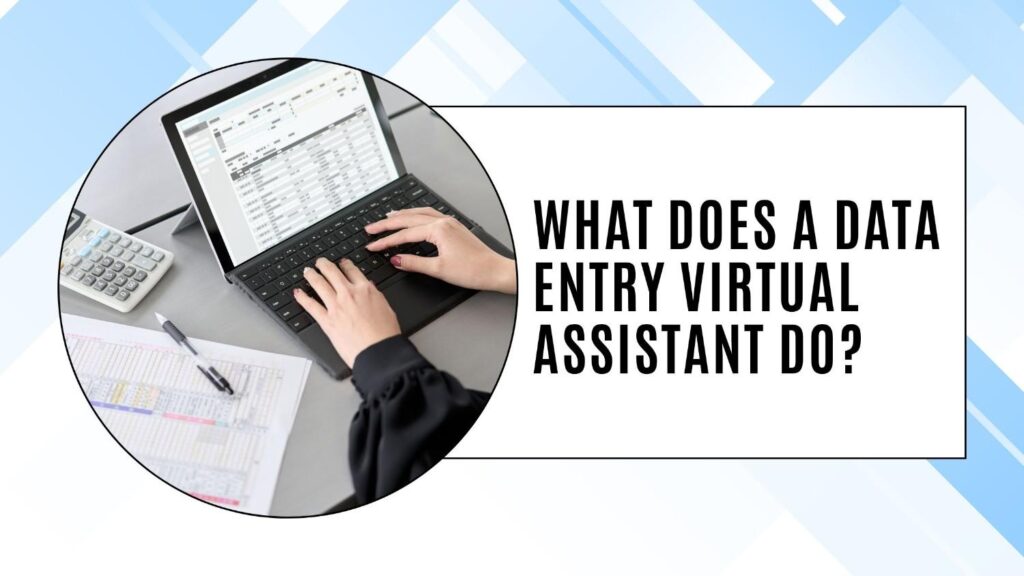
A data entry virtual assistant keys in your information, checks it, sorts it across your systems, and keeps it tidy as time goes on. The job runs deeper than typing. A good one spots a mistake before it spreads, and treats your data as something to look after rather than just fill.
The usual tasks:
- Data input: customer orders, leads, and financial transactions, entered quickly and accurately.
- Data cleansing: hunting down duplicates, fixing formatting, and checking details so the data is actually usable.
- Record updates: keeping CRM entries, contact lists, and databases current.
- Document conversion: turning paper, PDFs, and images into structured digital files.
- Spreadsheet work: building and formatting sheets, writing formulas, and setting up simple macros.
- Reporting: pulling numbers into the routine reports your team reads at a glance.
Typing by hand is never spotless. Benchmarks put manual data entry error rates somewhere between 1 and 4 per cent, which is exactly why the checking and cleansing side of the job carries as much weight as the typing itself.
Services broken down by department

What the work looks like depends on the team being supported. The underlying skill holds steady while the context around it shifts. A capable VA can support teams from sales to HR:
- Sales: updating lead lists, filling the gaps in CRM data, and importing prospects from tools like ZoomInfo.
- Marketing: managing campaign lists, cleaning contact data, and pulling together performance numbers.
- Ecommerce: entering product details, prices, and images into your store. If that is your world, an ecommerce virtual assistant can take listings off your plate.
- Customer service: logging tickets, updating records, and keeping service spreadsheets current.
- Operations and HR: looking after data across staffing, benefits, expenses, and onboarding.
For most owners, this is the first job they let go of. If you are not sure what else belongs on that list, our guide on tasks to outsource to remote staff is a sensible next read.
The tools a data entry virtual assistant works in
A data entry virtual assistant mostly lives in spreadsheets and CRMs, with automation shuttling data between them. Most already know the same software your team runs, so getting started rarely takes long.
A typical stack:
- Spreadsheets: Microsoft Excel and Google Sheets, often with Power Query for cleanup.
- CRMs: HubSpot, Salesforce, and Zoho for customer records.
- Automation: Zapier to connect a web form to a sheet to a CRM with no manual re-keying.
- Databases: Airtable and similar, for structured records.
- Accounting: QuickBooks for invoices, expenses, and payroll entry.
- Project tools: Asana, Trello, or Slack, to track the work and report back.
Automation takes care of the repetitive transfers. The person handles the judgement calls: context, quality, and the odd exception the software gets wrong.
How much does a data entry virtual assistant cost?
A data entry virtual assistant usually runs $5 to $15 an hour offshore, or $20 to $45 an hour when the support is US-based, depending on how skilled and how complex the work is. Owners hiring part-time tend to spend $400 to $1,500 a month. Inside the US, the average virtual data entry wage sits close to $19.47 an hour, and PayScale puts a VA with data entry skills near $18.40 at the median.
Three things move the rate: where the person sits, how experienced they are, and whether you hire direct or go through a managed service. Offshore rates start around $5 an hour, while US-based help sits well above that.
| Option | Typical rate | Best for |
| Offshore VA | $5 to $15 / hr | High-volume, routine entry on a budget |
| US-based VA | $20 to $45 / hr | Sensitive data, calls that need judgement |
| Monthly retainer | $400 to $1,500 / mo | A steady, predictable part-time workload |
Set that against what your own hour is worth. If an hour of your time bills a client $150, burning it re-keying rows on a $10 job is a bad trade. Before you commit, our guide on tasks you can afford to outsource helps you run that math honestly.
In-house vs outsourced: the honest trade-off

Keeping data entry in-house can absolutely be the right call. If your data is highly sensitive, tightly regulated, or baked into processes only a trained employee really understands, an on-site hire buys you control and oversight on the spot. That is a genuine advantage, and worth saying plainly.
Then there is the math. A full-time clerk comes with salary, benefits, software, and overhead, all for work that in practice fills maybe fifteen hours a week. You end up paying a full-time cost for a part-time job.
A data entry virtual assistant turns that around. You pay for the hours you actually use, drop the overhead, and still get someone trained on your tools. For most small and mid-sized businesses, it is simply the smarter option. When owners hesitate, it usually comes down to trust, and if that is your sticking point, these mindsets that block outsourcing are worth sitting with.
When a data entry virtual assistant makes sense (and when it doesn’t)

Bring in a data entry virtual assistant when the work is repetitive, high in volume, and eating hours you should be spending on something bigger. For most growing businesses, that is the situation. It will not suit everyone, though.
It fits when:
- You lose more than a few hours a week to manual entry.
- Your CRM or spreadsheets are full of errors and duplicates.
- You are scaling, and the data is piling up faster than your team can keep pace with.
- The work is routine enough to write down and hand off cleanly.
It fits less well if your data is so sensitive or specialised that only a supervised employee should go near it, or if the volume is genuinely tiny. Be straight with yourself about which camp you are in.
Conclusion
Hiring a data entry virtual assistant is one of the cheapest, highest-leverage hours you can hand off. The gist: the role now covers input, cleansing, and reporting right across your stack; rates land anywhere from $5 to $45 an hour depending on who you hire and where they sit; and the software is the same kit your team already opens every day. Clean data goes unnoticed right up until it breaks. The businesses that handed this off months back are already busy with harder, more valuable problems.
So the only real question left is how many more hours you feel like spending re-keying rows yourself. Talk to our team today and get matched with a data entry virtual assistant who fits the way your systems work.